Compare the Graph-AI Functions
Pick a well-known function, watch how it is presented, and see the Graph-AI templates that cover the same ground.
DES Business description
DES is a well-known function about the business description of a company. On the left, its presentation video. On the right, the Graph-AI templates used for describing a given business.
Video: Bloomberg. Not affiliated with Bloomberg L.P.
Graham & Dodd Nature of the Business
Benjamin Graham and David Dodd set out a way of analyzing the nature of the business in Security Analysis (1934). The Graph-AI functions below are inspired by their framework; not endorsed. Basic Description and Trend are live, more are on the way.
-
Graham & Dodd Basic Description
Gives a good overview of the company using a 15-question framework: one operations node and three subnodes.
References
Security Analysis"The descriptive function [of security analysis] consists in marshaling the important facts relating to an issue and presenting them in a coherent, readily intelligible manner."
"Analyzing a security involves an analysis of the business. Such a study could be carried to an unlimited degree of detail; hence practical judgment must be exercised to determine how far the process should go."
Question framing
15 questions, in four groups. The full text of each question is in the prompts below.
Operations (3 questions)
- Products and services
- Geographic locations
- Physical vs. digital operations
Revenue Streams & Mix (4 questions)
- Monetization mechanics
- Segment & revenue mix breakdown
- Revenue recognition & timing
- Pricing power & contract terms
Products and Services (4 questions)
- Core offerings inventory
- Primary value utility
- Delivery & fulfillment mechanism
- Product lifecycle & maturity
Customer Base & End-Markets (4 questions)
- Buyer profile & distribution channels
- End-market verticals & demand cyclicality
- Customer concentration risk
- Customer retention & switching dynamics
Structure
The template is an Euler graph. The root node is the one you click to launch the due diligence on "Basic Description". It leads to an Operations node, which in turn leads to three subnodes: Revenue Streams & Mix, Products and Services, and Customer Base & End-Markets.
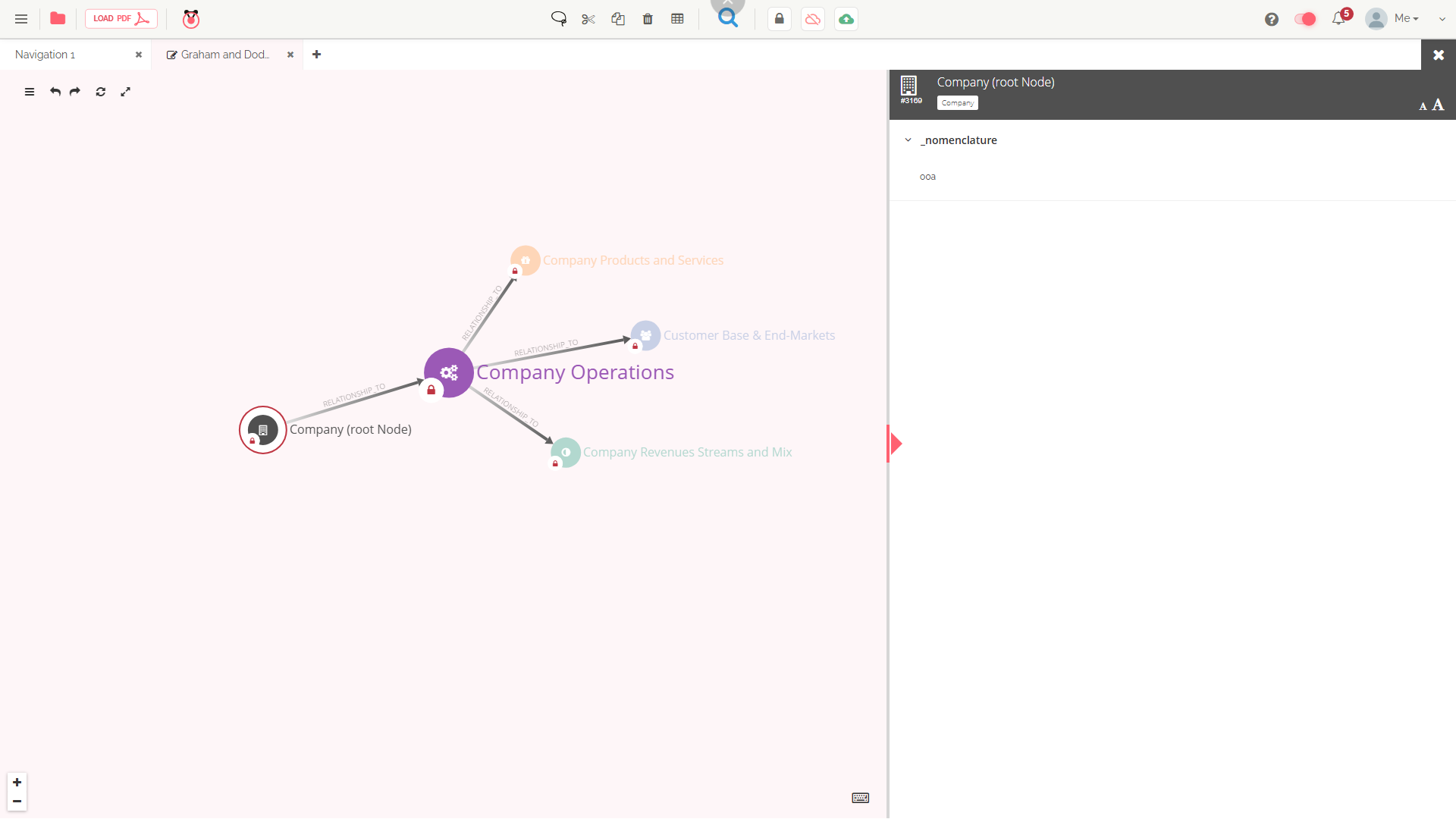
Root node Predicate 1: How the Operations node is built. The system uses two LLMs:
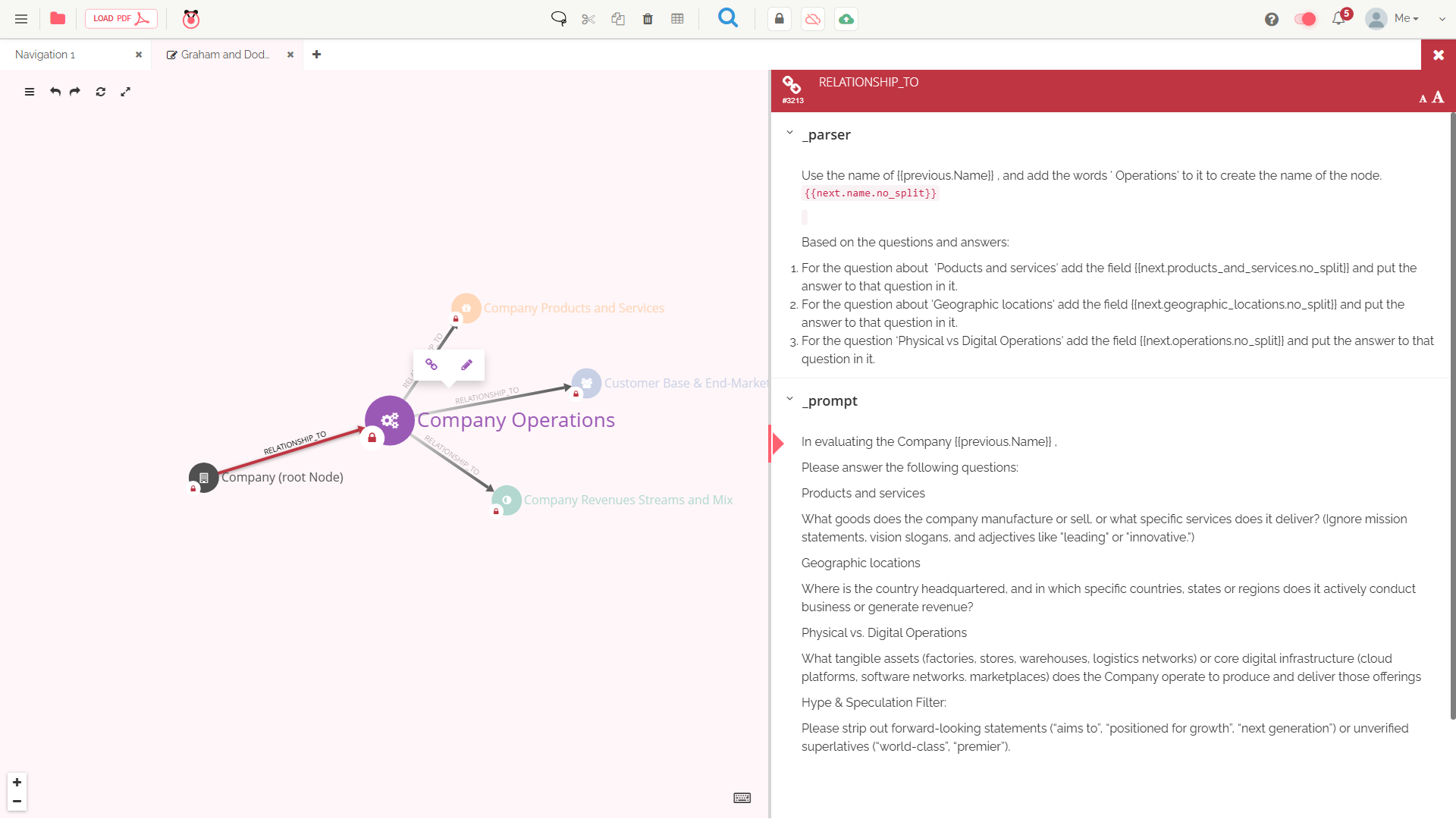
Predicate 1 -
_prompt: the first LLM finds the information, using the prompt.
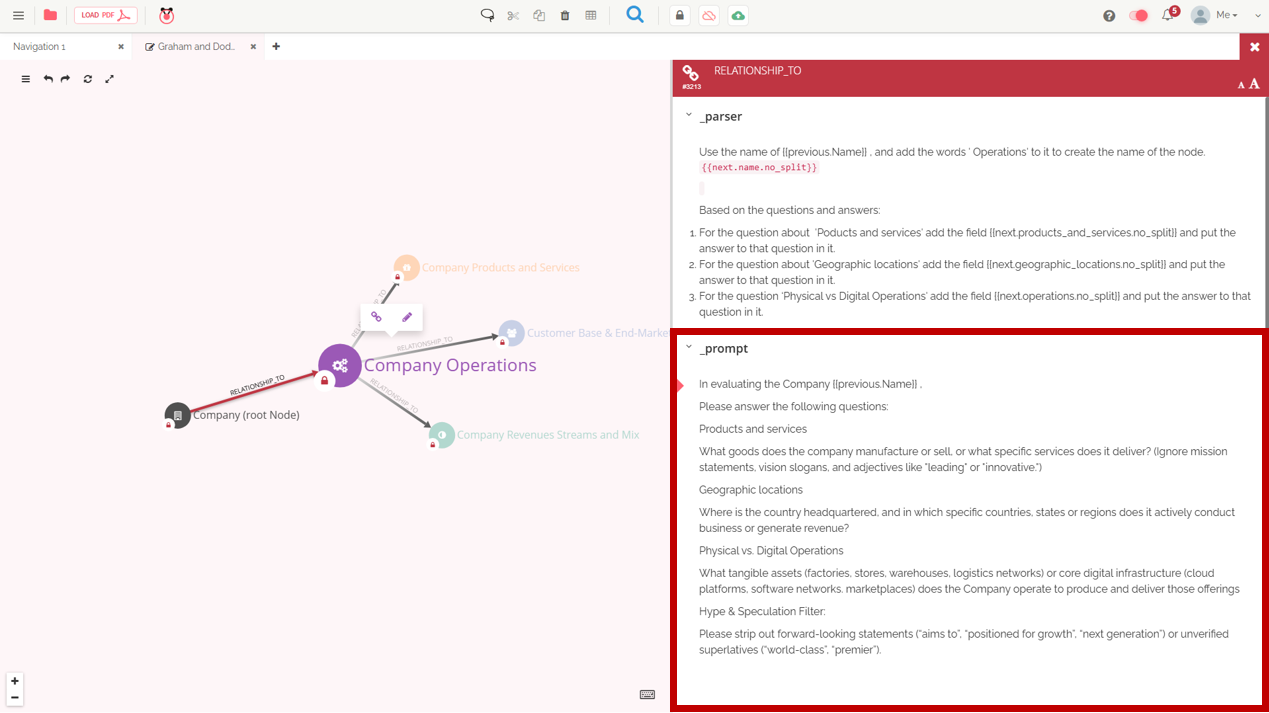
Prompt for 1st Predicate In evaluating the Company {{previous.Name}}, Please answer the following questions: Products and services What goods does the company manufacture or sell, or what specific services does it deliver? (Ignore mission statements, vision slogans, and adjectives like "leading" or "innovative.") Geographic locations Where is the company headquartered, and in which specific countries, states or regions does it actively conduct business or generate revenue? Physical vs. Digital Operations What tangible assets (factories, stores, warehouses, logistics networks) or core digital infrastructure (cloud platforms, software networks, marketplaces) does the Company operate to produce and deliver those offerings? Hype & Speculation Filter: Please strip out forward-looking statements (“aims to”, “positioned for growth”, “next generation”) or unverified superlatives (“world-class”, “premier”). -
_parser: the second LLM sorts and organizes the data.
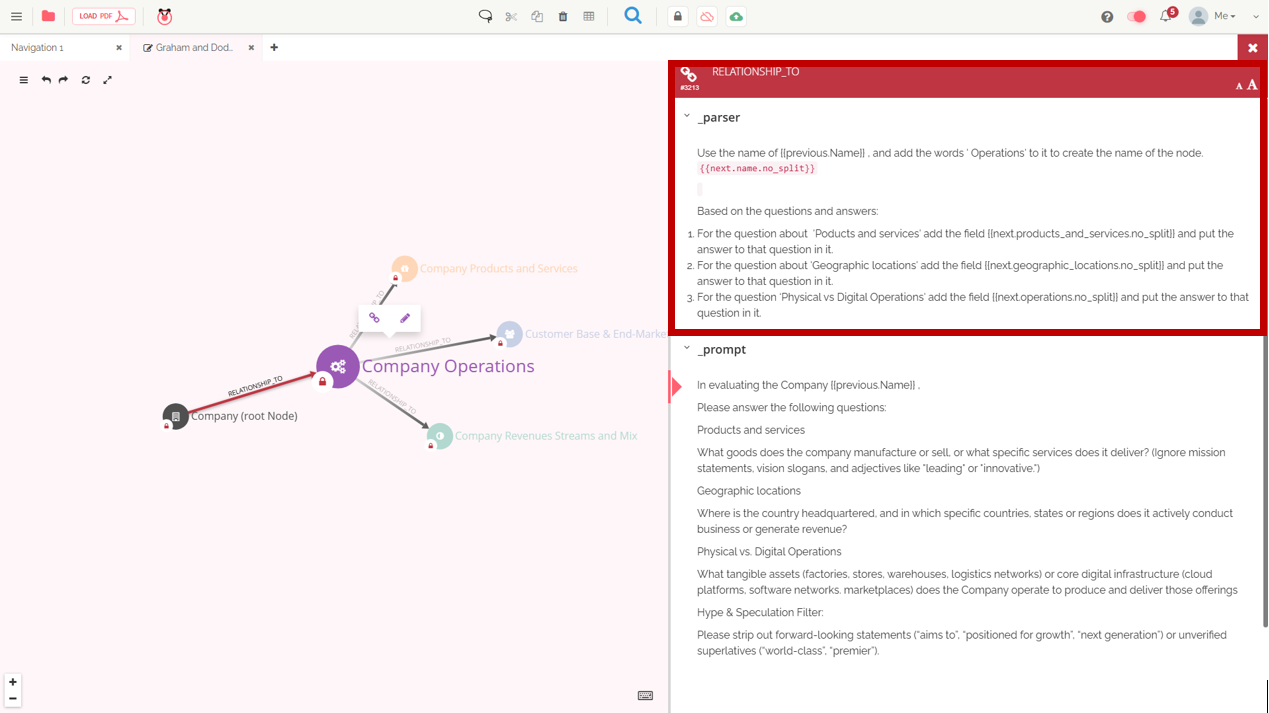
Parser for 1st Predicate Use the name of {{previous.Name}}, and add the words 'Operations' to it to create the name of the node. {{next.name.no_split}} Based on the questions and answers: 1. For the question about 'Products and services' add the field {{next.products_and_services.no_split}} and put the answer to that question in it. 2. For the question about 'Geographic locations' add the field {{next.geographic_locations.no_split}} and put the answer to that question in it. 3. For the question 'Physical vs. Digital Operations' add the field {{next.operations.no_split}} and put the answer to that question in it.
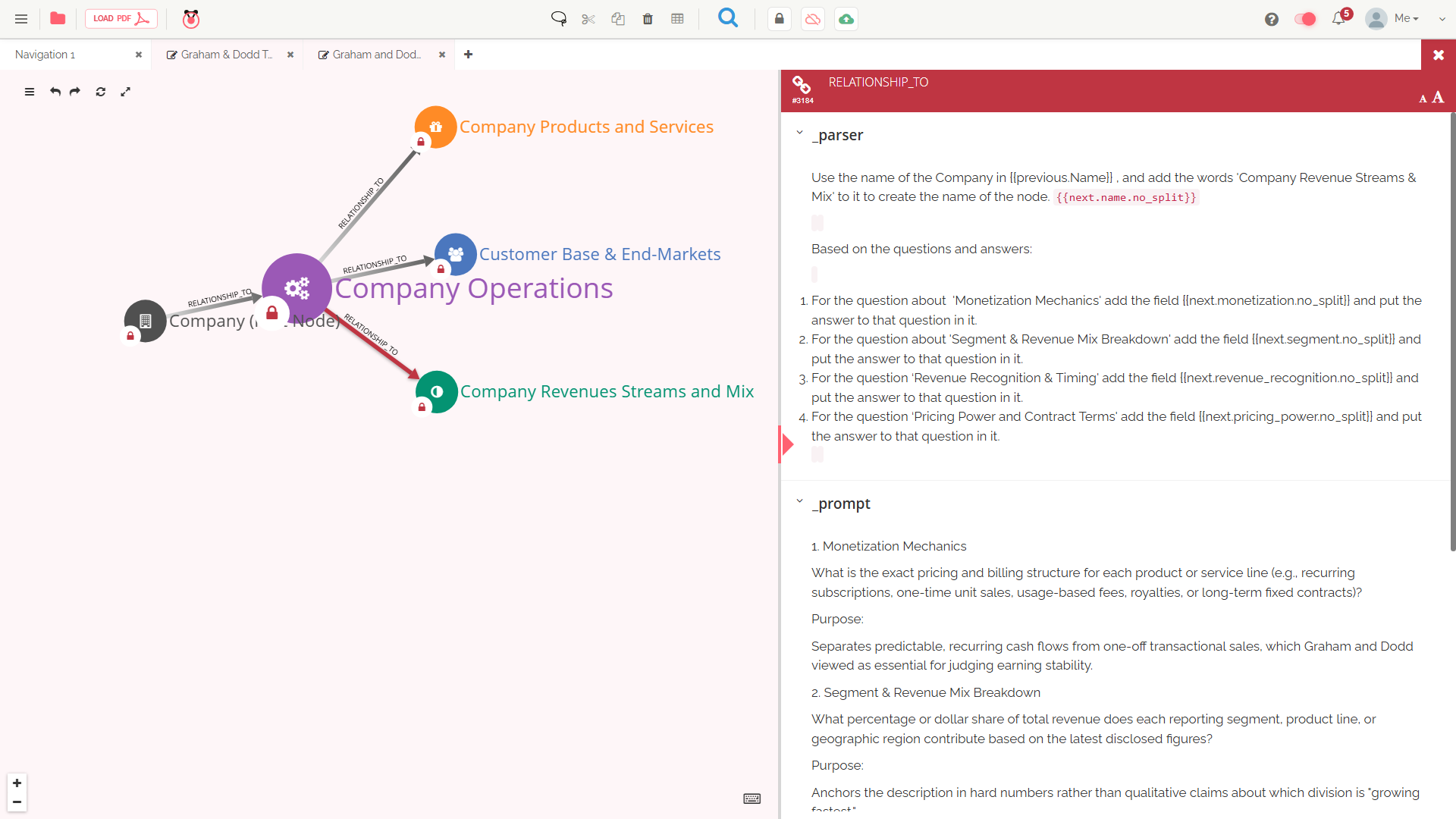
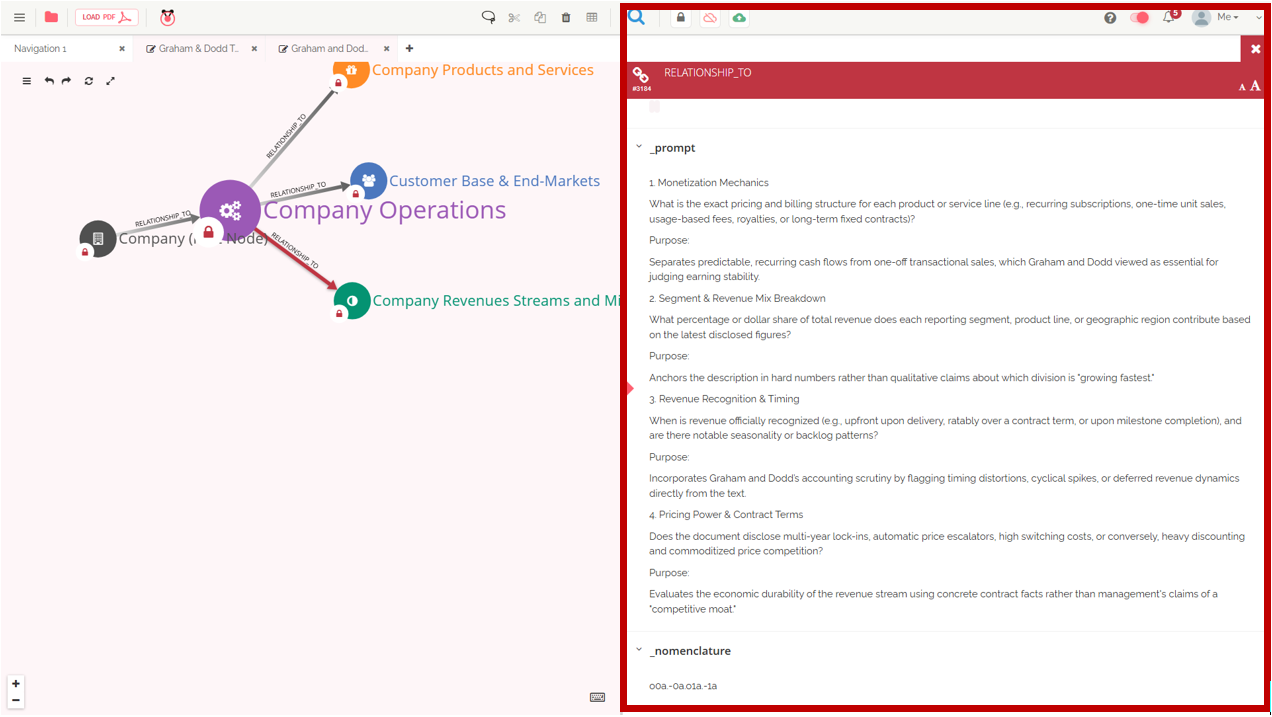
Predicate 2: How Revenue Streams & Mix is built. From the Operations node, the system uses two LLMs:
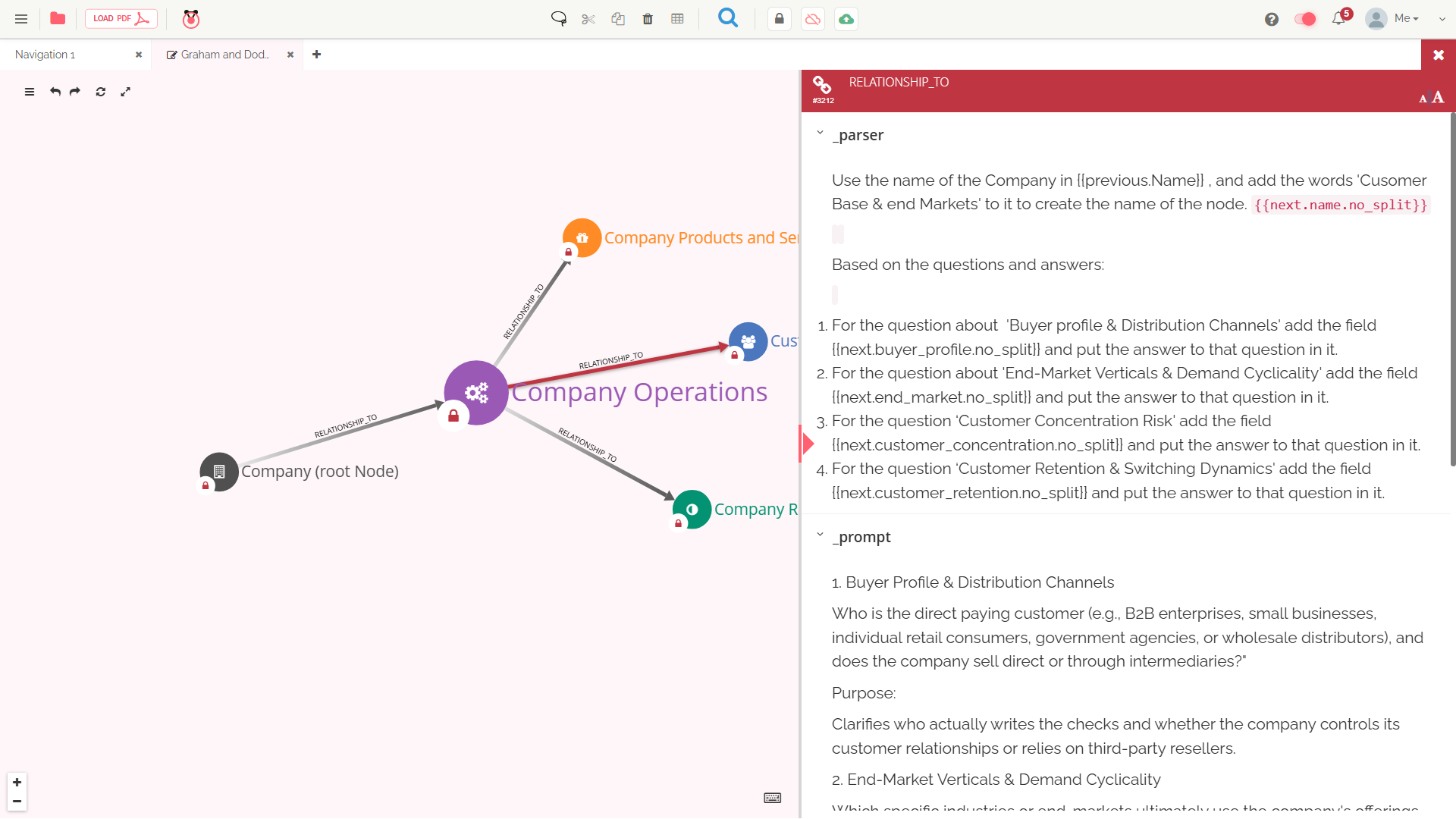
Predicate 2 -
_prompt: the first LLM finds the information, using the prompt.
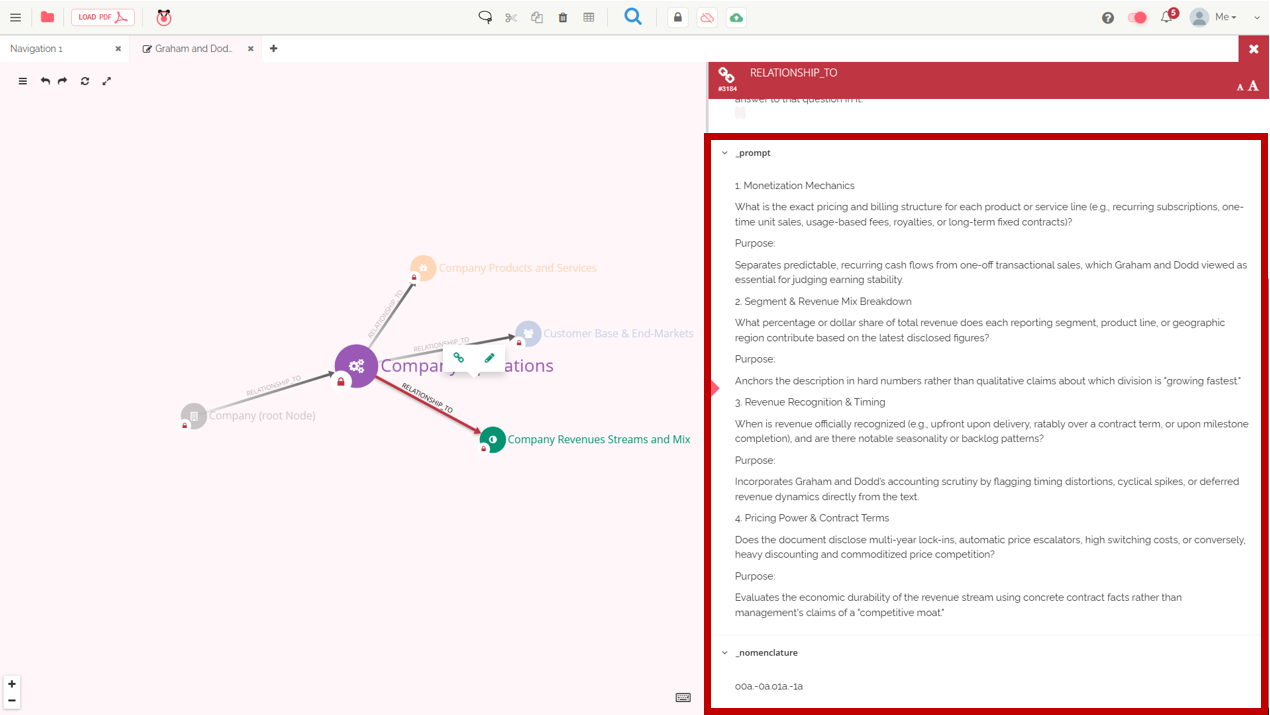
Prompt for 2nd Predicate 1. Monetization Mechanics What is the exact pricing and billing structure for each product or service line (e.g., recurring subscriptions, one-time unit sales, usage-based fees, royalties, or long-term fixed contracts)? Purpose: Separates predictable, recurring cash flows from one-off transactional sales, which Graham and Dodd viewed as essential for judging earning stability. 2. Segment & Revenue Mix Breakdown What percentage or dollar share of total revenue does each reporting segment, product line, or geographic region contribute based on the latest disclosed figures? Purpose: Anchors the description in hard numbers rather than qualitative claims about which division is "growing fastest." 3. Revenue Recognition & Timing When is revenue officially recognized (e.g., upfront upon delivery, ratably over a contract term, or upon milestone completion), and are there notable seasonality or backlog patterns? Purpose: Incorporates Graham and Dodd’s accounting scrutiny by flagging timing distortions, cyclical spikes, or deferred revenue dynamics directly from the text. 4. Pricing Power & Contract Terms Does the document disclose multi-year lock-ins, automatic price escalators, high switching costs, or conversely, heavy discounting and commoditized price competition? Purpose: Evaluates the economic durability of the revenue stream using concrete contract facts rather than management's claims of a "competitive moat."
-
_parser: the second LLM sorts and organizes the data.
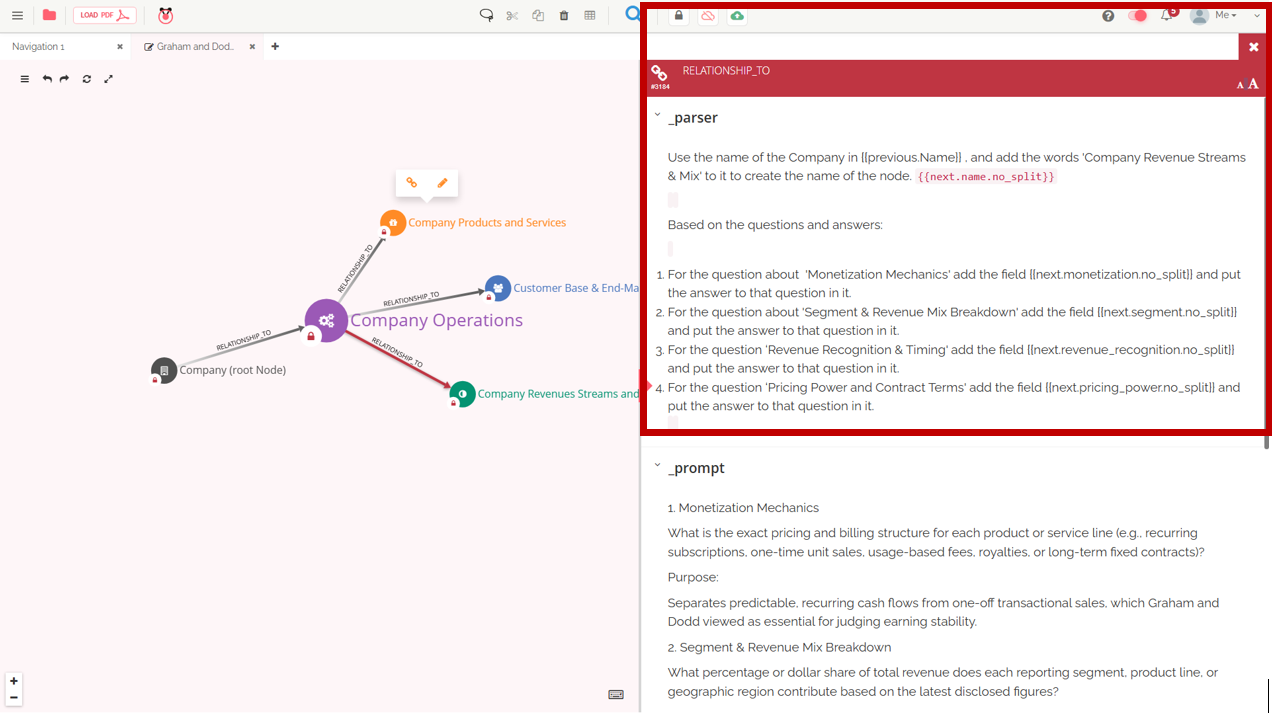
Parser for 2nd Predicate Use the name of the Company in {{previous.Name}}, and add the words 'Company Revenue Streams & Mix' to it to create the name of the node. {{next.name.no_split}} Based on the questions and answers: 1. For the question about 'Monetization Mechanics' add the field {{next.monetization.no_split}} and put the answer to that question in it. 2. For the question about 'Segment & Revenue Mix Breakdown' add the field {{next.segment.no_split}} and put the answer to that question in it. 3. For the question 'Revenue Recognition & Timing' add the field {{next.revenue_recognition.no_split}} and put the answer to that question in it. 4. For the question 'Pricing Power and Contract Terms' add the field {{next.pricing_power.no_split}} and put the answer to that question in it.
Predicate 3: How Products and Services is built. Also from the Operations node, the system uses two LLMs:
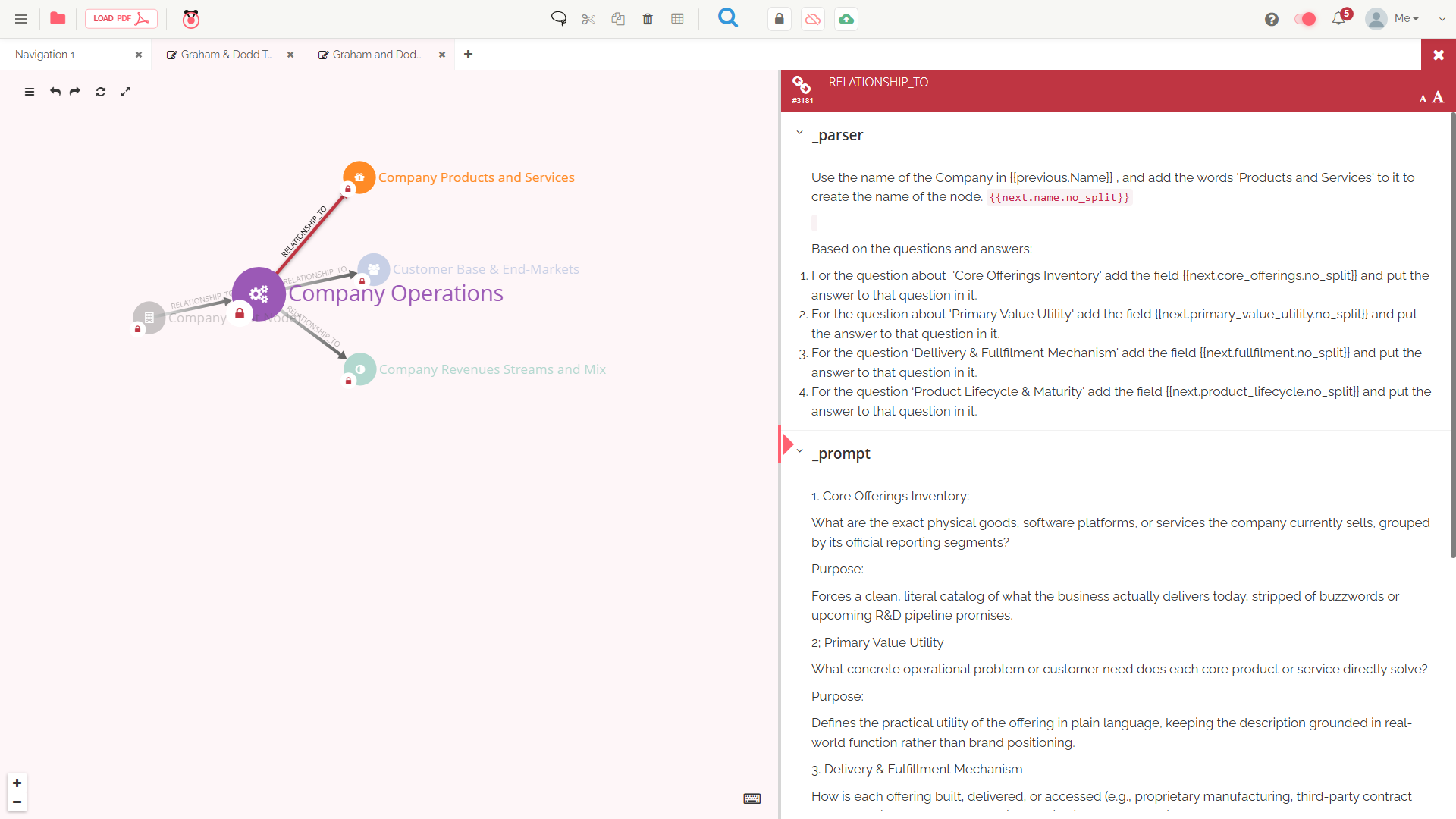
Predicate 3 -
_prompt: the first LLM finds the information, using the prompt.
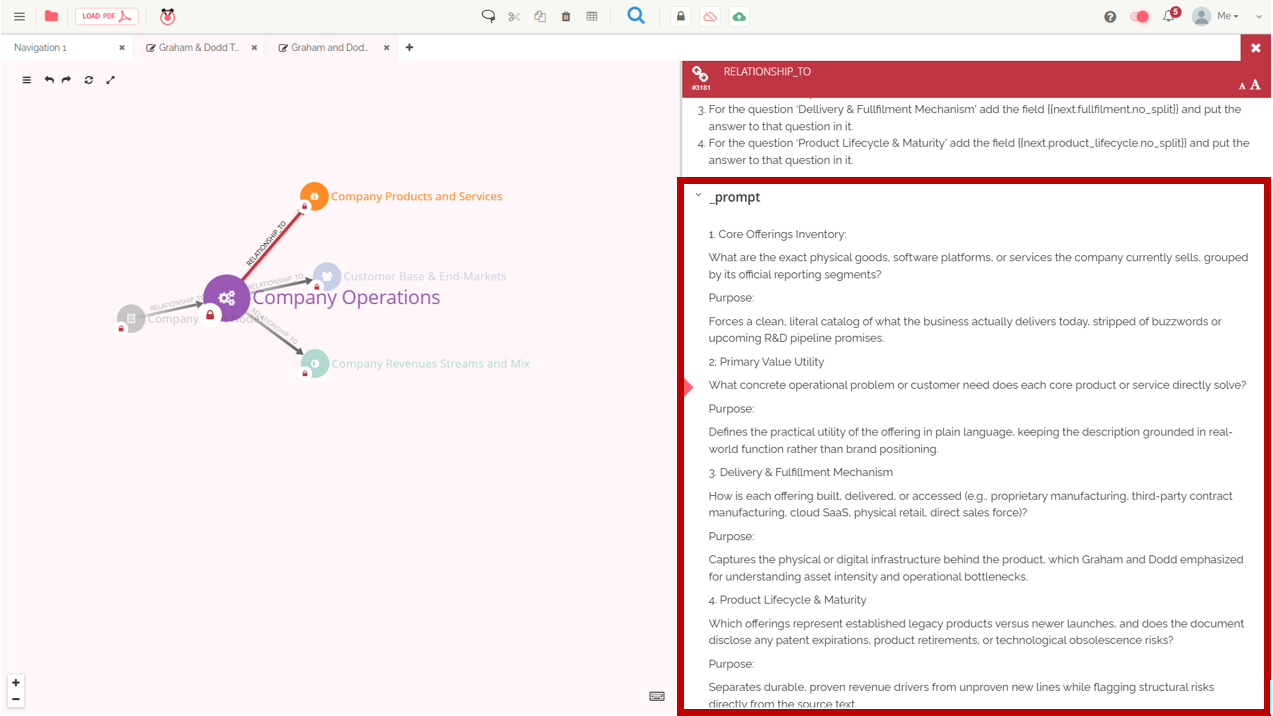
Prompt for 3rd Predicate 1. Core Offerings Inventory What are the exact physical goods, software platforms, or services the company currently sells, grouped by its official reporting segments? Purpose: Forces a clean, literal catalog of what the business actually delivers today, stripped of buzzwords or upcoming R&D pipeline promises. 2. Primary Value Utility What concrete operational problem or customer need does each core product or service directly solve? Purpose: Defines the practical utility of the offering in plain language, keeping the description grounded in real-world function rather than brand positioning. 3. Delivery & Fulfillment Mechanism How is each offering built, delivered, or accessed (e.g., proprietary manufacturing, third-party contract manufacturing, cloud SaaS, physical retail, direct sales force)? Purpose: Captures the physical or digital infrastructure behind the product, which Graham and Dodd emphasized for understanding asset intensity and operational bottlenecks. 4. Product Lifecycle & Maturity Which offerings represent established legacy products versus newer launches, and does the document disclose any patent expirations, product retirements, or technological obsolescence risks? Purpose: Separates durable, proven revenue drivers from unproven new lines while flagging structural risks directly from the source text.
-
_parser: the second LLM sorts and organizes the data.
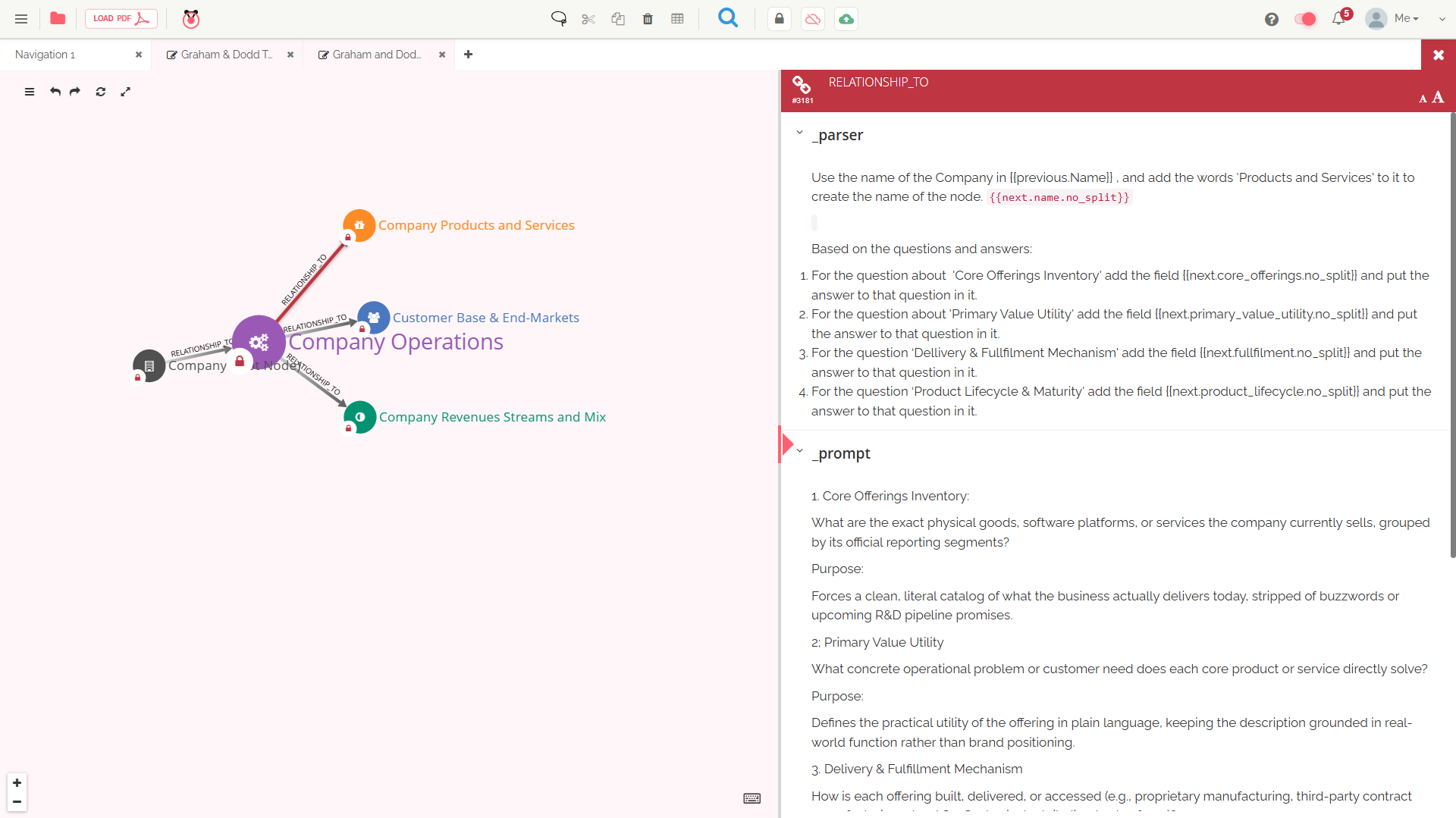
Parser for 3rd Predicate Use the name of the Company in {{previous.Name}}, and add the words 'Products and Services' to it to create the name of the node. {{next.name.no_split}} Based on the questions and answers: 1. For the question about 'Core Offerings Inventory' add the field {{next.core_offerings.no_split}} and put the answer to that question in it. 2. For the question about 'Primary Value Utility' add the field {{next.primary_value_utility.no_split}} and put the answer to that question in it. 3. For the question 'Delivery & Fulfillment Mechanism' add the field {{next.fullfilment.no_split}} and put the answer to that question in it. 4. For the question 'Product Lifecycle & Maturity' add the field {{next.product_lifecycle.no_split}} and put the answer to that question in it.
Predicate 4: How Customer Base & End-Markets is built. Also from the Operations node, the system uses two LLMs:
Predicate 4 -
_prompt: the first LLM finds the information, using the prompt.
Prompt for 4th Predicate 1. Buyer Profile & Distribution Channels Who is the direct paying customer (e.g., B2B enterprises, small businesses, individual retail consumers, government agencies, or wholesale distributors), and does the company sell direct or through intermediaries? Purpose: Clarifies who actually writes the checks and whether the company controls its customer relationships or relies on third-party resellers. 2. End-Market Verticals & Demand Cyclicality Which specific industries or end-markets ultimately use the company's offerings, and does the text characterize demand in those sectors as recession-resistant, cyclical, seasonal, or tied to capital expenditure budgets? Purpose: Connects directly to Graham and Dodd's concept of inherent stability, showing whether customer demand holds steady during downturns or collapses when clients cut budgets. 3. Customer Concentration Risk Does any single customer, distributor, or government agency account for 10% or more of total revenue, or does a small group of top accounts represent a disproportionate share of sales? Purpose: Captures mandatory SEC 10-K concentration disclosures (the 10% rule) to highlight single-point-of-failure risks where losing one buyer would impair earning power. 4. Customer Retention & Switching Dynamics What concrete facts are disclosed regarding customer retention, contract renewal rates, churn, or regulatory/technical switching barriers? Purpose: Measures how sticky the customer base is using factual operational metrics or structural constraints rather than management's claims of "strong customer loyalty."
-
_parser: the second LLM sorts and organizes the data.
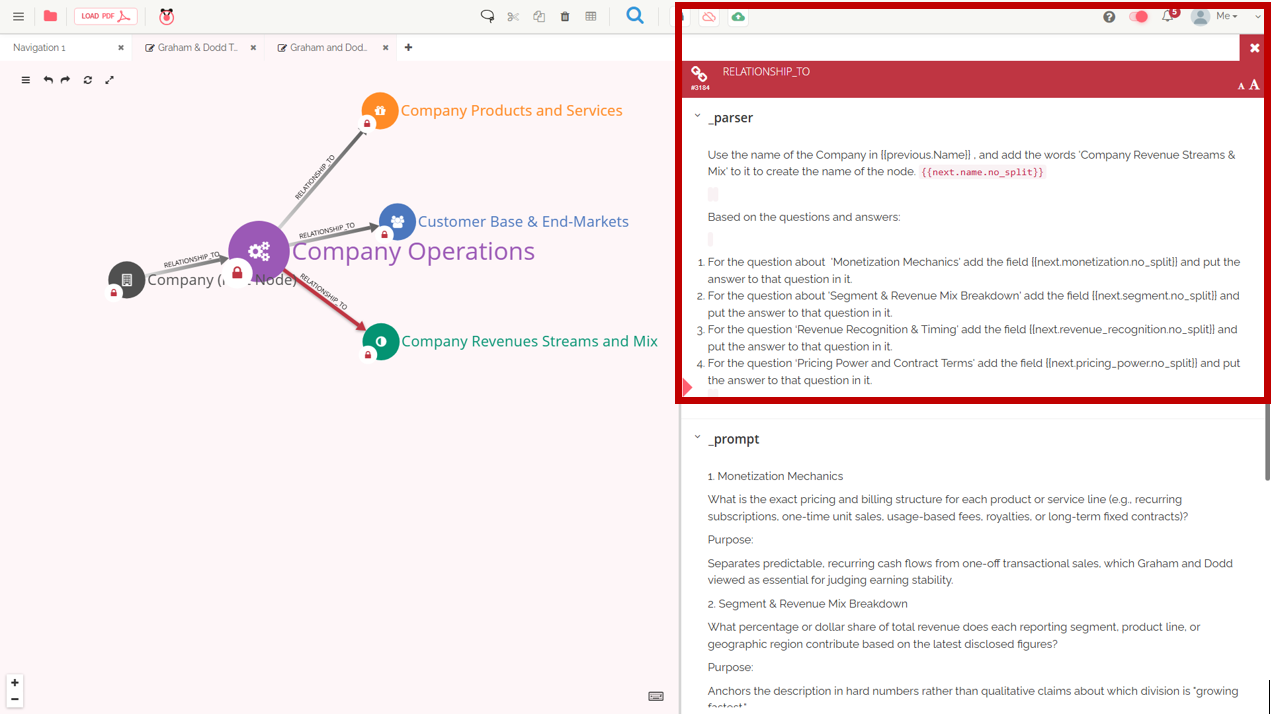
Parser for 4th Predicate Use the name of the Company in {{previous.Name}}, and add the words 'Customer Base & End-Markets' to it to create the name of the node. {{next.name.no_split}} Based on the questions and answers: 1. For the question about 'Buyer Profile & Distribution Channels' add the field {{next.buyer_profile.no_split}} and put the answer to that question in it. 2. For the question about 'End-Market Verticals & Demand Cyclicality' add the field {{next.end_market.no_split}} and put the answer to that question in it. 3. For the question 'Customer Concentration Risk' add the field {{next.customer_concentration.no_split}} and put the answer to that question in it. 4. For the question 'Customer Retention & Switching Dynamics' add the field {{next.customer_retention.no_split}} and put the answer to that question in it.
-
Graham & Dodd Trend
Tests whether an industry's rise is a lasting trend or a glamour cycle, using seven questions.
References
Security Analysis"The chief disadvantage of the qualitative approach is that it is exceptionally difficult to judge the future prospects of an industry or a company with any degree of accuracy... The analyst must be on his guard against accepting a popular trend as a permanent trend."
The Intelligent Investor (1949)Later, in his solo book The Intelligent Investor (1949), Benjamin Graham addressed this exact concept using the term "glamorous prospects" or "glamour" when discussing growth stocks:
"The obvious prospect of physical growth in a business does not translate into obvious profits for investors... The investor cannot reliably predict which companies in a glamorous industry will actually survive and prosper long-term."
Question framing
- Is this industry relatively new?
- Do we have a reliable history of how this industry works?
- Did the industry swing sharply upward in revenue and profit recently, versus its historical past?
- Has it captured a large share of media attention recently?
- Has it seen significant capital raising in the last couple of years?
- Has it been framed as "transformative" or a "new paradigm"?
- Have we seen messianic-style narratives around it in the media?
Structure
The template is an Euler graph. The root node is the one you click to launch the due diligence on "Trend".
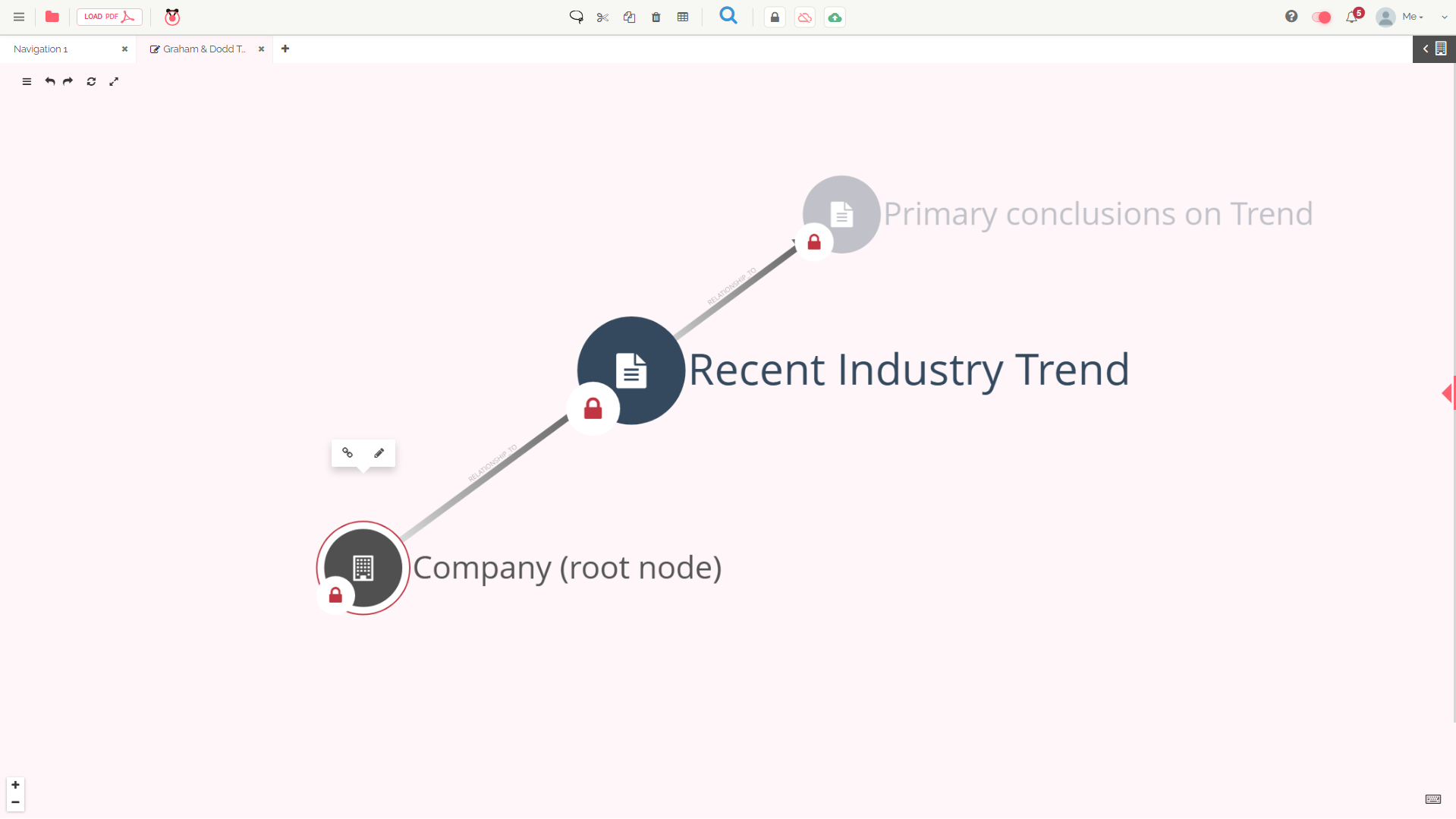
Root node Predicate 1: How the Recent Industry Trend is Built. The system uses two LLMs:
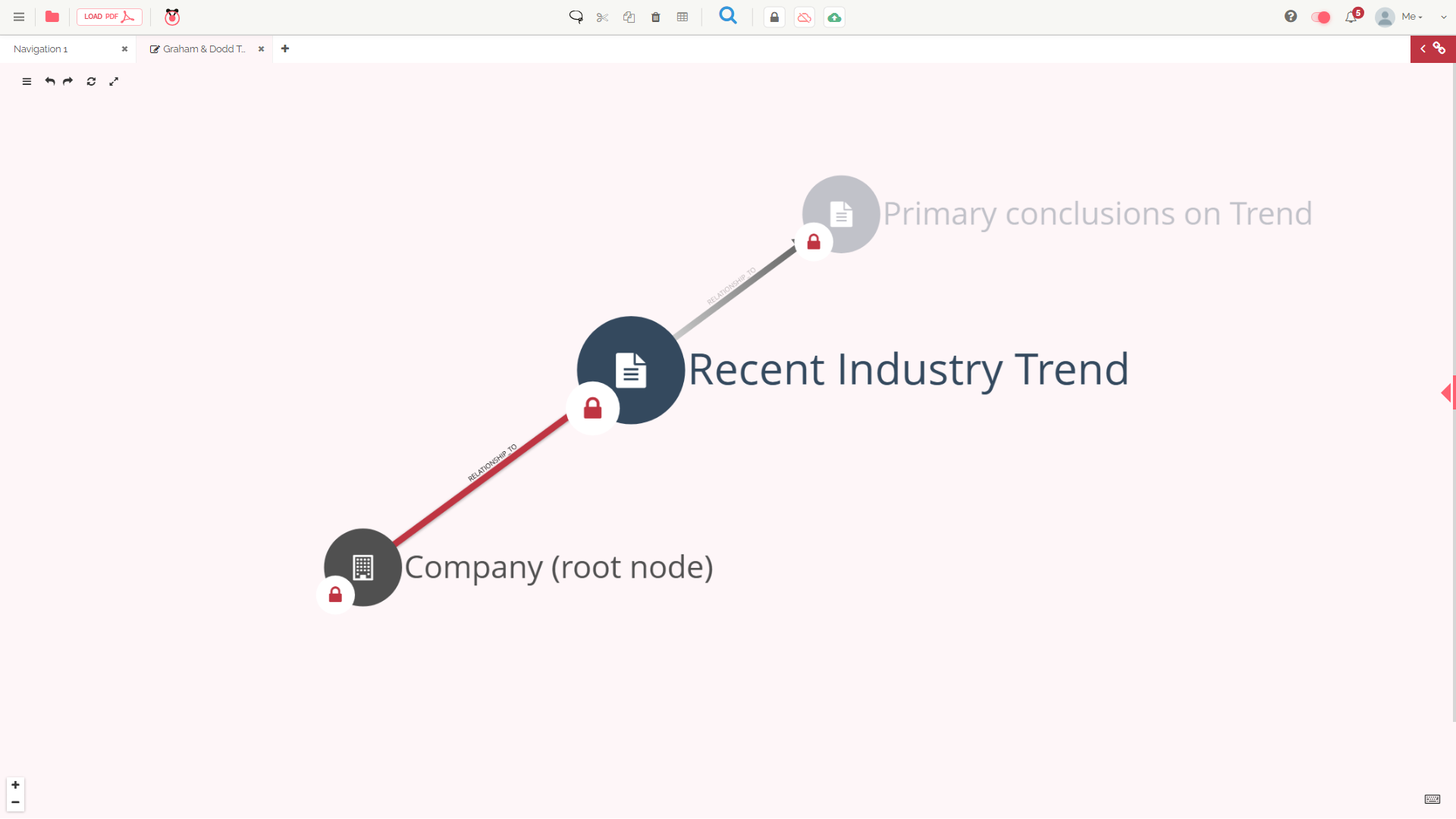
Predicate 1 -
_prompt: the first LLM finds the information, using the prompt.
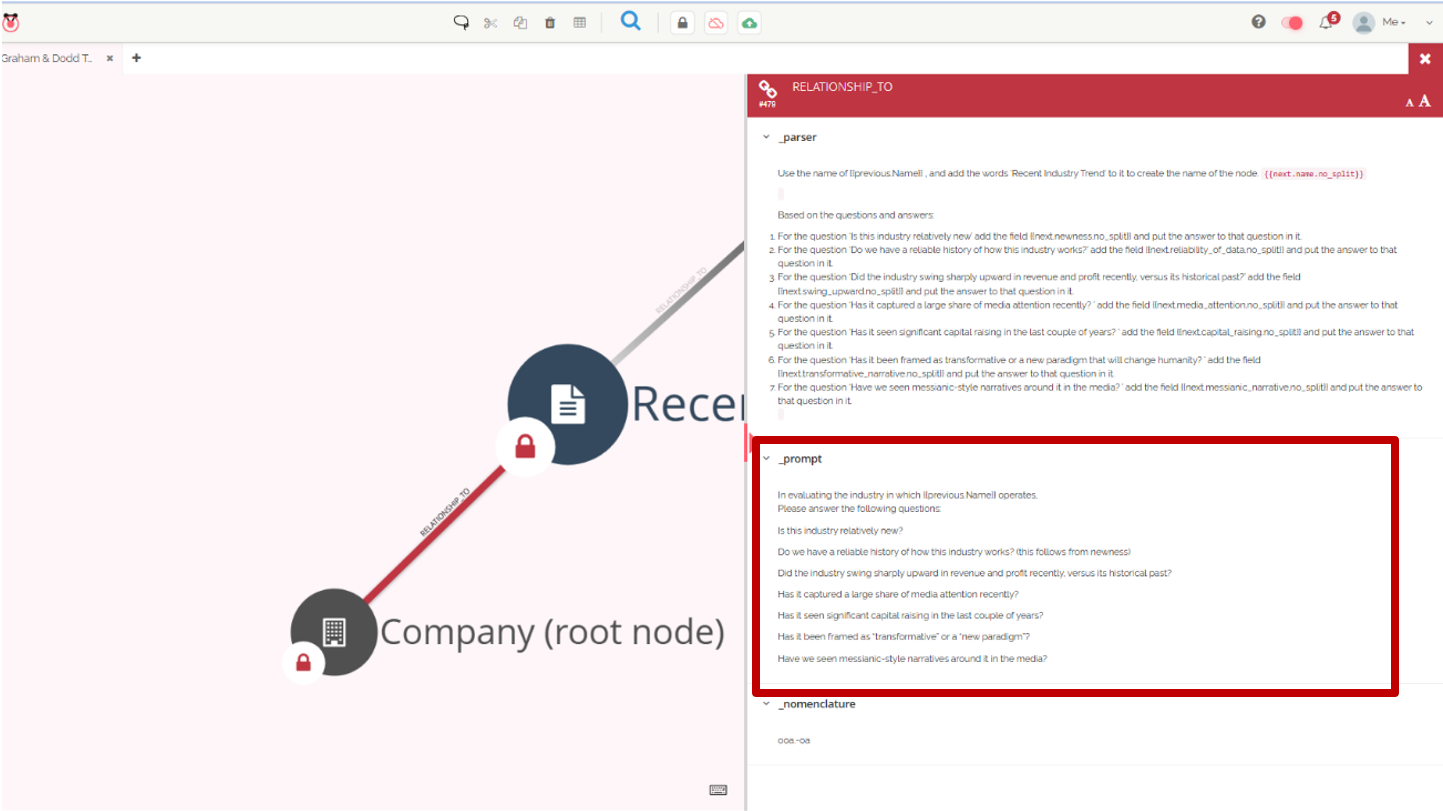
Prompt for 1st Predicate In evaluating the industry in which {{previous.Name}} operates, Please answer the following questions: Is this industry relatively new? Do we have a reliable history of how this industry works? (this follows from newness) Did the industry swing sharply upward in revenue and profit recently, versus its historical past? Has it captured a large share of media attention recently? Has it seen significant capital raising in the last couple of years? Has it been framed as “transformative” or a “new paradigm”? Have we seen messianic-style narratives around it in the media? -
_parser: the second LLM sorts and organizes the data.
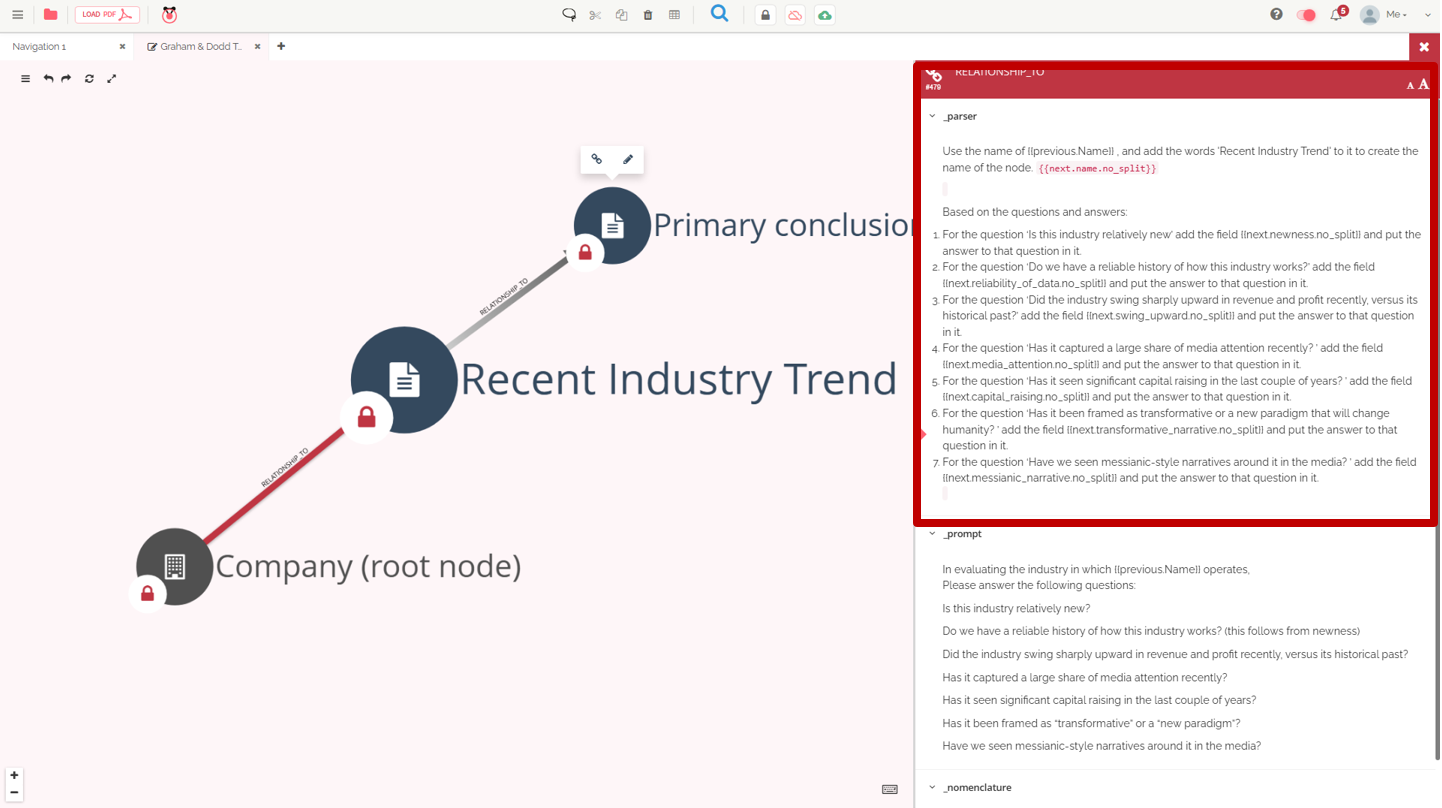
Parser for 1st Predicate Use the name of {{previous.Name}}, and add the words 'Recent Industry Trend' to it to create the name of the node. {{next.name.no_split}} Based on the questions and answers: 1. For the question ‘Is this industry relatively new’ add the field {{next.newness.no_split}} and put the answer to that question in it. 2. For the question ‘Do we have a reliable history of how this industry works?’ add the field {{next.reliability_of_data.no_split}} and put the answer to that question in it. 3. For the question ‘Did the industry swing sharply upward in revenue and profit recently, versus its historical past?’ add the field {{next.swing_upward.no_split}} and put the answer to that question in it. 4. For the question ‘Has it captured a large share of media attention recently?’ add the field {{next.media_attention.no_split}} and put the answer to that question in it. 5. For the question ‘Has it seen significant capital raising in the last couple of years?’ add the field {{next.capital_raising.no_split}} and put the answer to that question in it. 6. For the question ‘Has it been framed as transformative or a new paradigm that will change humanity?’ add the field {{next.transformative_narrative.no_split}} and put the answer to that question in it. 7. For the question ‘Have we seen messianic-style narratives around it in the media?’ add the field {{next.messianic_narrative.no_split}} and put the answer to that question in it.
Predicate 2: How the summaries are built. The system uses two LLMs:
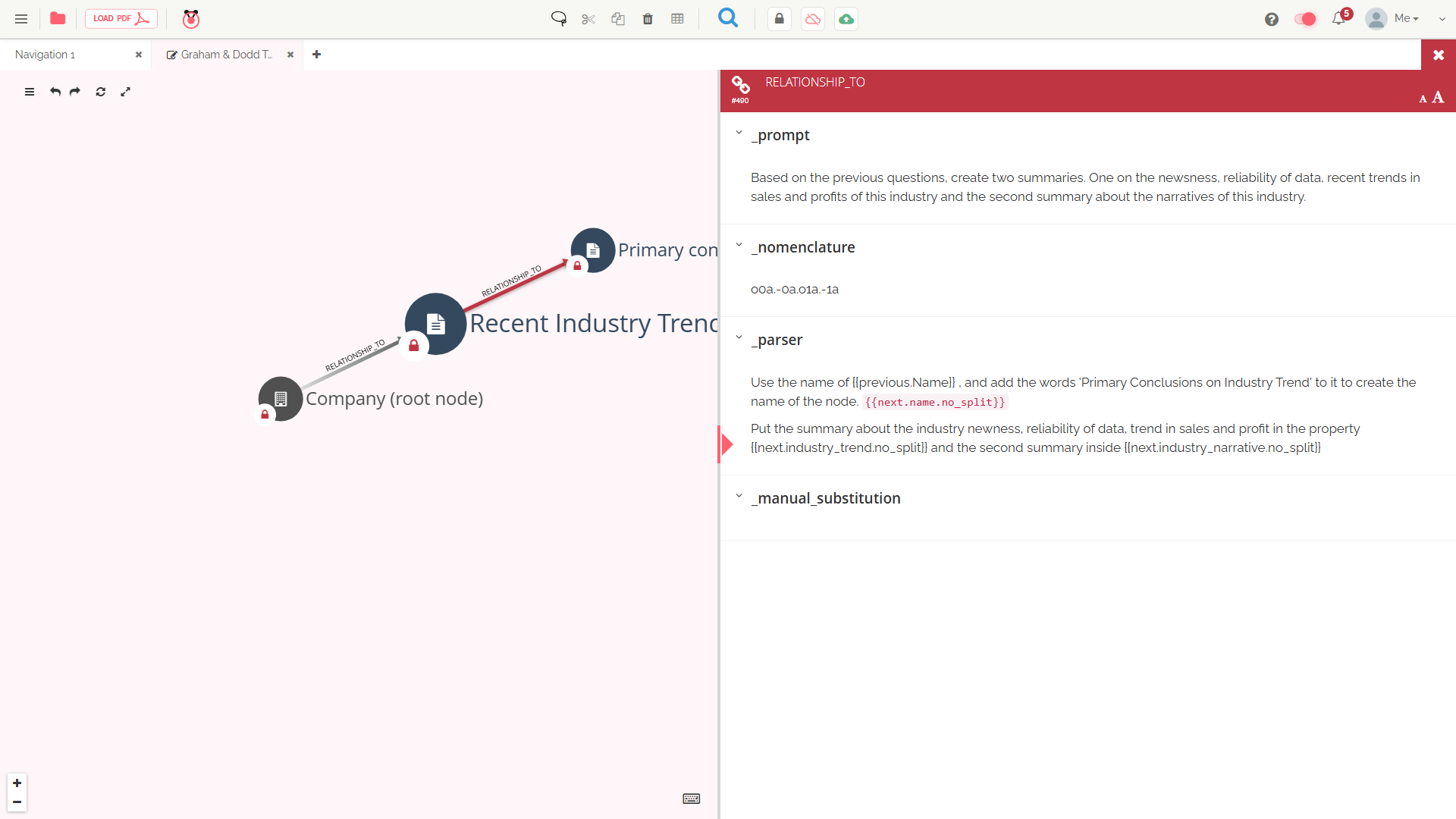
Predicate 2 -
_prompt: the first LLM finds the information, using the prompt.
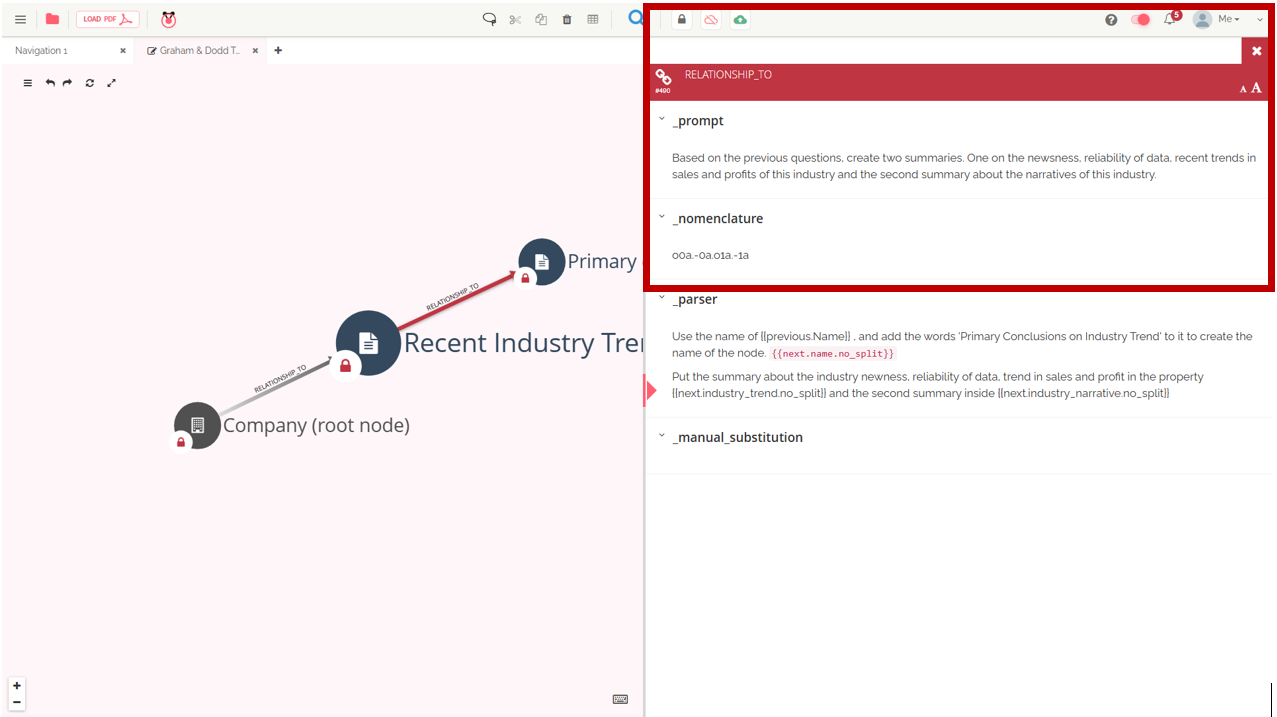
Prompt for 2nd Predicate Based on the previous questions, create two summaries. One on the newsness, reliability of data, recent trends in sales and profits of this industry and the second summary about the narratives of this industry.
-
_parser: the second LLM sorts and organizes the data.
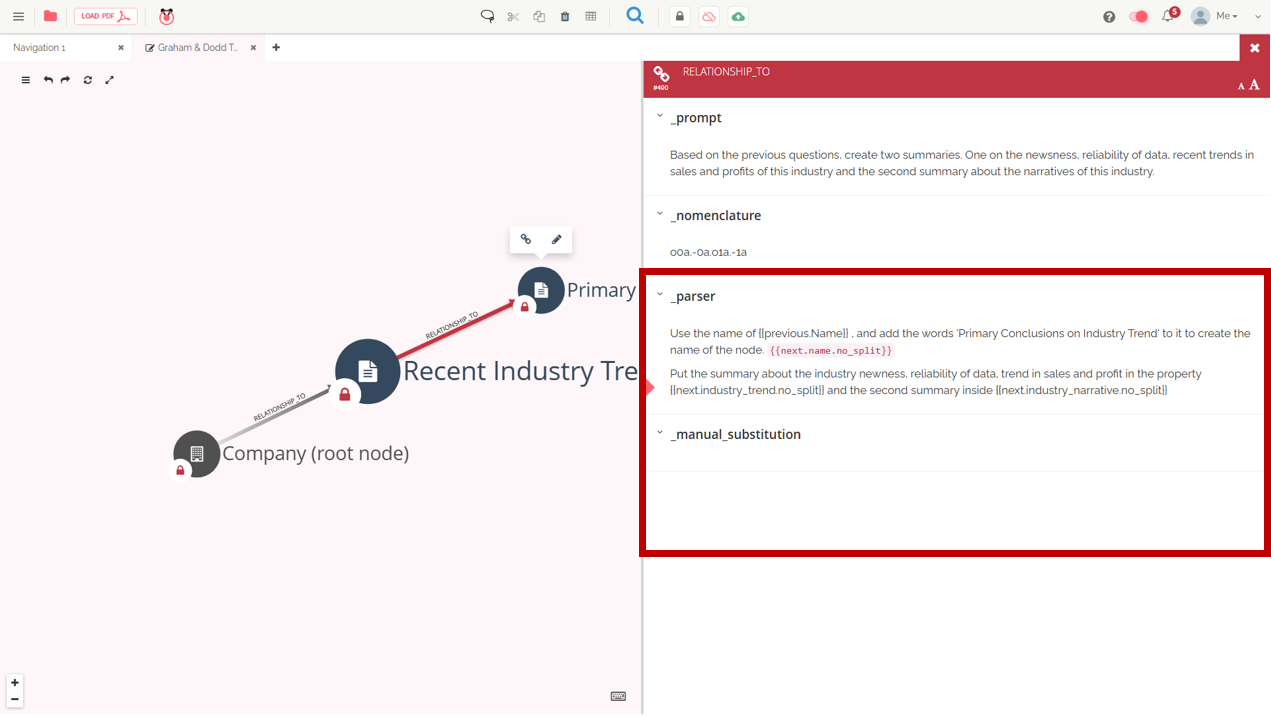
Parser for 2nd Predicate Use the name of {{previous.Name}} , and add the words 'Primary Conclusions on Industry Trend' to it to create the name of the node. {{next.name.no_split}} Put the summary about the industry newness, reliability of data, trend in sales and profit in the property {{next.industry_trend.no_split}} and the second summary inside {{next.industry_narrative.no_split}}
-
Nature of the business: industry dynamics Coming soon
How the industry is structured and what drives it.
-
Nature of the business: economic positioning Coming soon
Where the business stands economically within its industry.
-
Nature of the business: regulatory factors Coming soon
The rules and regulation that shape the business.
Bloomberg and its function names are trademarks of Bloomberg Finance L.P. and are used here only to identify the functions shown. GraphCall is not affiliated with or endorsed by Bloomberg.